Critter Flux-O-Matic
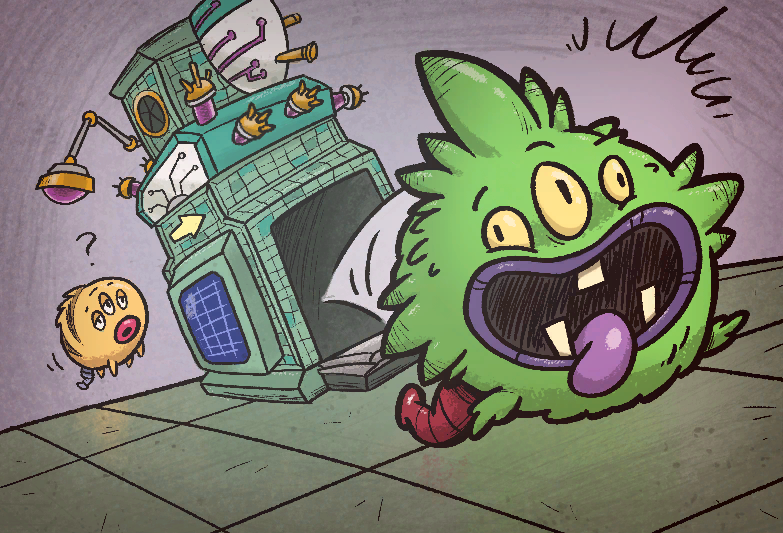
Critter Flux-O-Matic
Explore a revolutionary genetic manipulation device designed for critters.Whether or not it was ever used on non-critter subjects is unclear. Its DNA database has been wiped clean.
Ceramic Morb
A pottery project produced in an HR-mandated art therapy class.It's glazed with a substance that once landed a curious lab technician in the ER.
First Encounter
I've discovered an experiment designed to analyze the evolutionary dynamics of critter mutation.Once it has gathered enough data, it could prove extremely useful for genetic manipulation.
Hatches
Specimen attempted to snack on the buccal smear. Sample is viable, though the apparatus may be somewhat mangled.Atomic force microscopy of the bite pattern reveals traces of goethite, a mineral notable for its exceptional strength.
Shine Bugs
This critter kept trying to befriend the reflective surfaces of the scanner's interior.During examination, it cycled through a consistent pattern of four rapid flashes of light, a brief pause and two flashes, followed by a longer pause.Its cells appear to contain a mutated variation of oxyluciferin similar to those catalogued in bioluminescent animals.
Slicksters
Incessant wriggling made it difficult to scan this critter. Difficult, but not impossible.
Dreckos
This critter hardly seemed to notice it was being examined at all.The built-in scanning electron microscope has determined that the fibers on this critter's train grow in a sort of trinity stitch pattern, reminiscent of a well-crafted sweater.The critter's leathery skin remains cool and dry, however, likely due to an apparent lack of sweat glands.
Morbs
DNA results confirm: this species is the scientific definition of "icky".
Pufts
This critter bumped up against the building's interior repeatedly during scanning. Despite this, its skin remains surprisingly free of contusions.Fluorescence imaging reveals extremely low neuronal activity. Was this critter asleep during analysis?
Pacus
This species flopped wildly during analysis. Surfaces that came into contact with its scales now display a thin layer of viscous scum. It does not appear to be corrosive.Initiating fumigation sequence to neutralize fishy odor.
Moos
WARNING: METHANE OVERLOAD. This scanner was unable to analyze this subject due to overheating caused by excessive gas production.This organism's genetic makeup will remain shrouded in mystery.
Shove Voles
This critter felt right at home in the cramped scanning bed. It can't wait to come back!
Pips
This species has a secondary set of inner eyelids that act as a barrier against ocular splinters.The surfaces of these secondary eyelids are a translucent blue and display a light crosshatch texture.This has broad implications for the critter's vision, meriting further exploration.
Pokeshells
This species responded to the hum of the scanner machinery by waving its pincers in gestures that seemed to mimic iconic moves of the disco dance era.Is it possible that it might have been exposed to music at some point in its evolution?
Divergents
Specimen responded gently to the probative apparatus, as though being careful not to cause any damage.It also produced a series of deep, rhythmic vibrations during analysis. An attempt to communicate with the sensors, perhaps?
Plug Slugs
Warning: The electrical charge emitted by this specimen nearly short-circuited this building.
Beetas
This species may not be fully sentient, but it possesses a strong collective consciousness.It is unclear how information is communicated between members of the species. What is clear is that knowledge is being shared and passed down from one generation to another.Monitor closely.
Spigot Seals
This critter's pupils appear to be permanently constricted, possibly as a result of long-term exposure to excess illumination.Its sense of smell is extremely well-developed, however: it immediately identified areas touched by previous species, and marked each one with a small puddle of liquid ethanol.
Bammoths
Specimen produced substantial stool sample directly onto scanner bed.Remarkably, its white coat remained pristine. Analysis of coat fibers revealed that each follicle is sealed with polytetrafluoroethylene, providing strong stain resistance.
Floxes
This critter's perpetual grin grew as it observed each step of the process extremely closely.Behavioral analysis indicates a tendency toward mischief. Close supervision - and minimal access to advanced machinery - is recommended.
Rhexes
This critter's x-ray imaging indicates that its cranial protrusion may not be a horn at all.It is not composed of live bone surrounded by a keratin-and-protein shell, but rather an ennervated, calcified structure. An illogically located tooth, or perhaps a rostrum?Fascinating.
Dartles
Scanning interrupted due to instrument displacement caused by specimen's lingual grasp.Residual markings left by specimen's tongue ridges and grooves are a 72% match to a set of unmarked fingerprints from the Gravitas personnel database.
Lumbs
This critter was temporarily stuck in the scanning area due to its size. It appeared to enjoy being shoved backward and forward on the conveyor belt during dislodgment.Upon finally reaching the exit, the critter seemed confused as to why the ride was over.
Gnits
On the surface of this critter's wings are thousands of microperforations. These appear to act as acoustic liners, allowing the Gnit to approach targets without the high-pitched whine of its wingbeats giving away its position.
Jawbos
This critter attacked the transducer.When the swallowed component was regurgitated, it was coated in microorganisms that predate this colony by at least several millenia.Unfortunately, it was reingested before analysis was completed.
Mimikas
This critter tucked its wings tightly around itself during scanning, and used its antennae to roll its body around the chamber.It seems that these sensory organs possess more musculature than those of similar species, despite their unassuming appearance. Of particular note: the critter's refusal to engage in this behavior outside of this contained environment.
Blowters
Specimen's microbiome tested positive for tetrodotoxin-producing bacteria.The neurotoxin concentration is well within the safe range, but predators may experience a temporary numbness of the mouth, tongue, and throat.
Seaquines
Specimen exhibited signs of extreme stress at being contained.Rapid onset hyperventilation resulted in violent expulsion of fine granules from specimen's snout. Content analysis indicates the presence of glass and electrolytes.
Orehulls
Specimen rocked back and forth against the overhead brush during scanning, emitting low gurgles that peaked when bristles came into contact with thinner areas of its carapace.These vocalizations may be categorized as "laughter". Further study needed.
Kelpoles
This critter became stressed and shed its tail during biopsy.Results indicate an unusually high pluripotent stem cell count. Specimen's tail regeneration was immediate; the original tail will be stored in this unit for further study.
Glo Squids
Camera view was obscured during scanning by one tentacle while others probed the environment.Mutated chemotactile receptors appeared to be both analyzing and mimicking the electrical signals emitted by equipment.
Beakons
This critter's body is coated in millions of dinoflagellates trapped within a microscopic layer of muscilaginous gel.
Slogos
This critter has vestigial eyes, barely able to distinguish light from dark.Instead, it possesses a dense mat of short cirri along its stomach that are used to navigate, as well as identify minerals fit for consumption.Specimen left enormous quantities of mucin in the chamber. Decontamination protocol engaged.
Challenge Completed
Success! Sufficient samples collected.I can now trigger genetic deviations in base morphs by sending them through the scanner.Existing variants can also be scanned, but their genetic makeup is too unstable to tolerate further manipulation.